
Creative Acts: Spaces for Stories, Voices, and Who we Are
Embracing the Power of Creativity – Values to Live By #5

Dear World,
A couple of weeks ago, I was delighted to be able to talk to the wonderful Paulette Edwards on BBC Radio Sheffield about my experiences of writing through my cancer diagnosis and treatment. In her segment entitled ‘Creative Lives’ I shared my thoughts about the value of writing and what it has offered me, personally, as a way to cope with the ups and downs of the last 18 months or so. You can listen to it here (from about 12:15pm): Creative Lives with Paulette Edwards.
It was a big step for me, speaking openly about my cancer and my writing on so public a platform. But Paulette put me at ease and provided such a welcoming and caring space in which to talk that I genuinely enjoyed the experience. And, like my Substack posts, I hoped that by opening up publicly, my words and thoughts and experiences might resonate with others. That by using my voice to talk about what it’s like living with and writing about cancer I may have helped at least one other person to find a way to cope with whatever traumas and challenges they are facing.
Writing, for me, quickly became a fundamental part of my coping strategies and, as I told Paulette, it has been nothing short of a lifeline. The first couple of months after my initial diagnosis I resisted it: it felt too frightening, to definite to put anything down in words. But from that first moment, when I picked up a pen and a notebook in the middle of the night and committed my thoughts to the page, I realised the power that writing as a form of creativity held for me.
In the act of writing, I created a space for myself, a space for my voice and sense of self to not just exist but to be reaffirmed and renewed. It was a space in which I could give a voice to the darkness, to release all the difficult thoughts and feelings that were filling my head, to be able to, importantly, acknowledge them and then let them go. It was also a space in which I could find and hold onto the moments of joy that were still there in my life – loved ones, connections, the world around me and which I was still engaging with despite my changed context. This creative space made of words gave me back my agency and helped me to hold onto my identity, whilst everything about the cancer tried to claim these from me.
And this, I think, is where the power and potency of creativity lie. By expressing ourselves in creative forms – be it words, images, sounds, lines on a page, paints, clay, music, dance – we are creating and claiming a space for our voice, our agency, and our sense of self. It doesn’t matter whether we are creating to share with others or simply creating for ourselves. It doesn’t matter if we return to and look back at our creations, or if we tear them up and discard them in the bin. The important thing is the act of creating, the space that we carve out by being creative. In this act, we are telling our own stories, crafting our own narratives, and that is a very powerful thing indeed.
Creativity has always been an important part of my life: through the years I’ve drawn and painted, dabbled with poetry, played the flute and the guitar, sung in the shower and in bands, danced in clubs, kitchens and muddy fields. I’ve also always enjoyed working creatively: exploring solutions to problems, making new connections, thinking of new ways to explain and teach ideas and concepts. And being creative has always filled me with a sense of calm and joy. But, until the Interloper (cancer) came knocking at my door, I don’t think I had ever really considered or given credit to the power it has as a tool for dealing with what life throws at you.
I believe we all hold that creative potential within us, but I think we can easily become caught up in the concept of creativity as something that has to be done a certain way, that meets some preconceived ‘standards’, and where what we produce is judged to be ‘good’ or ‘worthwhile’. With writing particularly, I think school experiences of a focus on spelling, handwriting and grammatical correctness can often obscure the real aim of writing to express, to communicate, to connect. But we are increasingly understanding the role that creativity plays in supporting our mental health and wellbeing, and it’s heart warming to see the proliferation of creative pursuits and the way in which these are being recognised as valuable ways to spend our time.
For the past month I’ve been lucky to be able to be part of a creative writing group, ‘Writing Through Cancer’, funded by our local cancer charity and led by Beverley Ward (founder of the Writers’ Workshop in Sheffield and who, as well as having published several books, has her own Substack: Cartwheels in the Graveyard). It’s been an amazing experience being part of this group - uplifting, reaffirming, and heart-breaking in equal measure. Being able to write alongside others affected by cancer, sharing our stories, hearing the words and thoughts of others that both resonate and provide new insights on what it means to try to cope with and come to terms with a cancer diagnosis and treatment.
It’s fascinating how our writing enables us to make connections between our stories, to see the points at which they converge, at the same time as allowing us to understand a little better the parts of each other’s journeys that are different and unique to us as individuals. We write about our relationships with our selves, with the cancer, but also with the world we live in – from custard cream biscuits to the trials of navigating the main hospital, to the things we wish people understood about what it’s like living with cancer, and everything in between. In these acts of creativity, we laugh (a lot), we cry sometimes, we pause and we listen and we reflect. We hold a space for ourselves and each other, we bear witness.
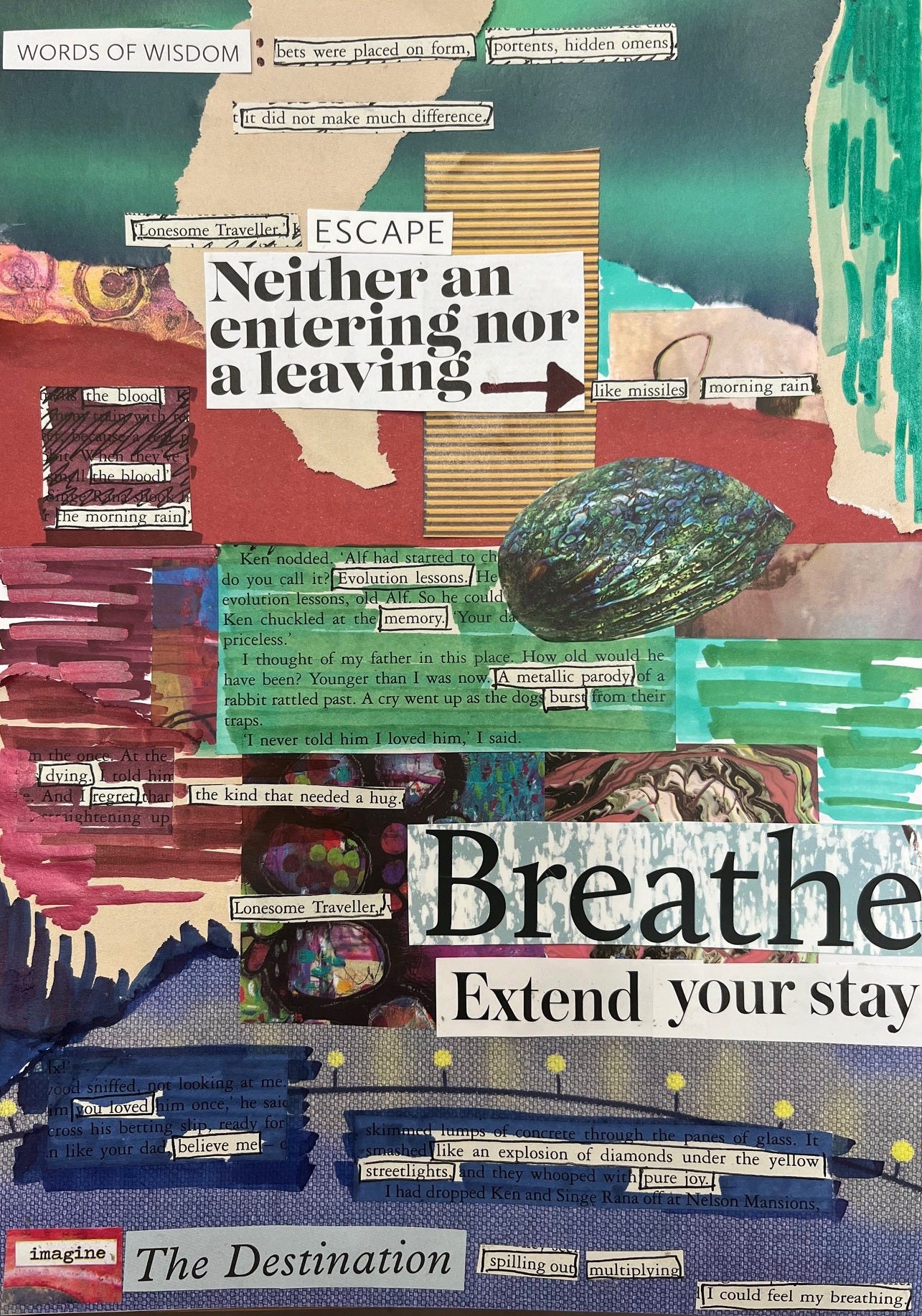
Last time we met, we spent the session focusing on a form of ‘found poetry’ where we selected words and phrases from a text to create a poem then developed this with collage to create a new visual and textual image. I loved this approach as it took some of the pressure of a blank page away from the act of creating. Instead, it was a process of finding, choosing, selecting, reordering; then cutting, moving, sticking, embellishing. It combined two of my favourite things - words and images – and was an empowering way of making new connections, physically taking hold of language and recrafting and reforming it in tangible ways to create something new. At the end of the session, we relished in the uniqueness of our individual creations and reflected on how relaxing and genuinely mindful the collaging process had been.
Creativity, it whatever form we choose to enact it, can both challenge us and soothe us. It can be a space where we acknowledge and give a voice to the darkness, but also one in which we can recognise joy, laughter, a sense of calm and peace. It is a way to express and understand, to listen and to be heard. As a value to live by it offers us the power to gain new perspectives, to see the world in a different way, whether through our own eyes or someone else’s. With our creative acts we can claim our agency and our sense of who we are, we can share our stories and let loose our voices.
In my interview with Paulette Edwards, she asked me what advice I would give to other people thinking about using writing to help with the challenges they’re facing. I told her that the most important thing is just to pick up a pen, a laptop, your phone, and just have a go, just start writing. Everyone needs to find their own way of writing, or, indeed, of being creative. Make that start and find out what works for you. Put aside the doubts, ignore that voice that might be telling you that you’re not creative, that you’re not good at creative things. It’s not about being ‘good’, it’s about being you. It’s about carving out that space for your own voice to be expressed and be heard, even if you’re only sharing it with yourself.
And so, Dear World, I will be continuing to make as much space and time for my creative acts as I can, relishing in the power of that creativity to hold a space for my stories, my voice, my sense of who I am. What creative ways will you choose to tell your own stories?
What an inspirational message for embracing creativity! Everything you've said relates to how art psychotherapists engage people in therapy and foster their creativity...I might have to steal some of your lines when I'm on my next mission to persuade a client to engage!
The decision to turn my diagnoses into narratives (drawn) has helped me. It’s a long term practice like meditation or yoga.